Showing posts with label book review. Show all posts

Thursday, May 01, 2008

Book Review - The Little Book That Builds Wealth

The Little Book That Builds Wealth: The Knockout Formula for Finding Great Investments.

I generally love short investment books. Too often, it seems to me, an author takes a couple of basic ideas - and rather than give concise, germane, explanations and examples - instead stretches the book out to be one or two hundred pages longer than necessary.

Thankfully, that isn't the case here with this great little book.

The author is Pat Dorsey who is the Director of Equity Research for investment research provider Morningstar. Mr. Dorsey takes Warren Buffett's popularized "economic moat" term and show you how you can analyze businesses to see whether they possess such an advantage.

After screening for an above average return (both return on assets [ROA] and return on equity [ROE]), you can begin to consider whether your potential investment target has a long-term business advantage - an economic moat. Mr. Dorsey explains the four most common sources of moats: intangible assets, cost advantages, customer-switching costs, and network economics.

In clear and concise language, he explains these moats and gives examples. Later chapters give you some valuation basics to ensure that you aren't acquiring your target at too high a price - something that is always deadly to superior investment returns. Finally, he also suggests when to sell an investment.

I believe that this book deserves a place on any long-term investor's bookshelf, and highly recommend it. I would like to thank Mr. Peter Knox of Wiley for providing me with a review copy.

Note: If you're on a blog aggregator, you can visit The Confused Capitalist here (or here: http://confusedcapitalist.blogspot.com/) for additional articles and exclusive content!


JW

The Confused Capitalist

Monday, April 09, 2007

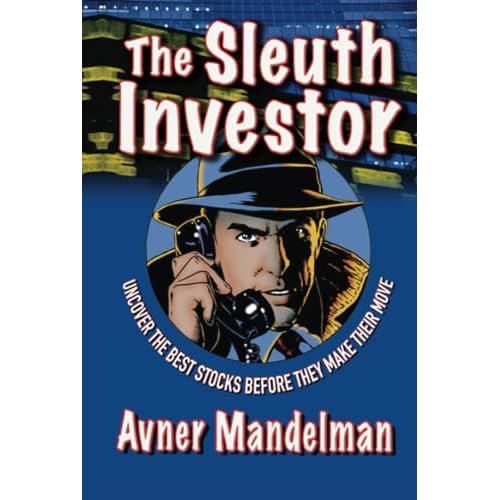
Book Review: The Sleuth Investor by Avner Mandelman

This is a book which every serious investor must acquire. A book which can help level the field between the large institutional investor, with all the attendant advantages, and the small investor like me.

While I own some 25+ investment books, including classics such as "Security Analysis", "One Up On Wall Street", and "Common Stocks and Uncommon Profits", I have to say that I think this book will prove to be the most personally enriching.

I could just tell right from the cover that this book, The Sleuth Investor, was going to be different from almost every investment book I've every read. Instead of a picture of Bulls or Bears, The Author, Dollars Floating in the Sky, or a Stock Exchange Building, instead there's a picture of what appears to be a private detective or, perhaps, a field operative. As I surmised from the cover, the book didn't disappoint.

And the dust cover picture cuts to the heart of the difference between this book and all the other investments books I've read. The difference between receiving second hand, "academic" information of stocks (eg annual and quarterly reports, etc.) or gathering that publicly available information, PLUS quality information directly from the field.

Note: If you're on a blog aggregator, you can visit the Confused Capitalist here for additional articles and exclusive content!

The author, Avner Mandelman, president and CEO of investment firm Giraffe Capital, tells you exactly how to sleuth out investment opportunities "in the field". He gives direct examples of what, who, how and when. This is not a book full of numbers and ratios; Mr. Mandelman knows full well that the investment world is full of these, yet the number of investors able to outperform the market is very few indeed.

In this book, he shows you how to both lower your investment risk profile, all the while increasing your odds of batting not just one, but numerous, investment home runs. While some investing books, such as Ken Fisher's "The Only Three Questions That Count: Investing by Knowing What Others Don't" state the importance of acquiring exclusive or near exclusive information, his book doesn't actually show you how to achieve that, since it only provides some further academic tools to suggest whether you might know something others might not know. On the other hand, if you apply Mr. Mandelman's suggested techniques, you'll know when you know something others don't when you are finished "sleuthing" a stock story.

I certainly haven't read any like it before, although there's hints of "One Up On Wall Street", by Peter Lynch here and there, and some visible heritage to "Common Stocks and Uncommon Profits", by Phillip A. Fisher. There's also some obvious lineage to Warren Buffett's ideas as well.

The book is a great read as well; it was the first investment book I've read since "On Up On Wall Street" by Peter Lynch that I when read it in bed, it was because it was so interesting, rather than because I intended as use it as a non-prescription sleep aid.

Canadian readers who've followed the business community here for a dozen years or so, will also especially savour a couple of the tales of "investment sleuths" from a couple of the high profile business stories and people here.

In one example, the "Z-Plat" story (almost certainly the Bre-X fraud) a sleuthing pension-fund manager saved his company a small fortune from physical sleuthing of a mining company's claim, and later turned that same information into a small personal fortune.

In another story, "Chipperware", Mr. Mandelman explains how he was able to turn a tidbit of public information about a piece of a one-of-a-kind designer clothing into a small fortune. One never knows of course, but many of the facts here appear to parallel some known public information about the wife of Corel Corporation's founder (Dr. Michael Cowpland), the flamboyant Marlene Cowpland, and an extremely expensive dress she wore to a gala.

Yes, as you read the stories of "Chipperware" and Z-Plat, be aware that these tales are almost certainly real business events as well.

In summary, this is an investment book that meets its dust cover promises. I cannot stress highly enough the importance of making this soon-to-be investment classic part of your permanent investment library.


JW

The Confused Capitalist

Thursday, March 22, 2007

A superior index arises: just a better mousetrap

This can either be read as a stand-alone posting relating to why fundamental indexing is a better way to go than tracking a conventional index, or it can also be read as part two of two of a book review of "The Little Book of Common Sense Investing", by John Bogle.

As relayed in part one of my review, I found the evidence presented by Mr. Bogle to be almost overwhelming that investing in a low-cost index fund was virtually the only way for the average equity investor to outperform the broad market, like the S&P 500, over time. A very good method as the book clearly details.

However, in the book (chapters 12, 14, 15 and 16), Mr. Bogle suggests that some of the new fundamental indices (e.g. FTSE RAFI) aren't going to stand up to the test of time, as market capitalization-weighted indices (such as the S&P 500) have. He intimates that, having seen various "better mousetraps" come and go, so too will fundamental indexing (which back-testing shows has outperformed a cap-weighted by nearly 2% annually, a huge margin). This is essentially, he claims, just another method to part the foolish from their prospect of future returns.

He denigrates the back-testing of these fundamental indices as if that was somehow undesirable. I personally fail to see the difference between the back-testing done there, and Mr. Bogle's own back-testing that led him to the conclusion that low-cost index investing was going to beat the then conventional mutual fund of the day (an advantage that has continued to hold up to this day).

Mr. Bogle fairly asks the question of why these fundamental factors (fundamental factors are centered on accounting items, like book value, dividends paid [or dividend growth rates], earnings, revenues, etc.) have not been properly exploited by stock markets in the past? While there have been tons of academic studies pointing out that a stock-picking method using virtually any of the aforementioned factors as a major stock-picking factor would have outperformed the broader market, that still doesn't really answer the question.

The question is best answered by examining behavioural research. In other words, it has to do with the emotional nature of people, something that even mutual fund managers are subject to, as clearly evidenced by the typical 100% turnover on the conventional mutual fund. Certainly, they also appear to be "taken in" by a "good story", as much as anyone. For more insight on this issue, see the following (warning: large pdf file) commentary, Seven Sins of Fund Management. In short, the problem is, my dear Mr. Bogle, interference from human beings.

Just as Mr. Bogle was then a pioneer of the day, by exploiting something seemingly obvious and mundane (i.e. 1. costs matter and 2. don't get trapped by "the story") it seems hard to believe that no one can build a method for a relatively sustainable advantage over a conventional index. In the future, the building of these fundamental indices today will probably be seen as something that should have occurred much earlier, given their obvious superiority.

But getting back to the business at hand, if, as alleged by Mr. Bogle early in the book, that long-term investment returns more or less parallel the returns of the stock market of the underlying businesses, doesn't it make sense to construct an index which actually gives weighting to those factors, as opposed to the more temporary and whimsical valuations imposed by market activity?

Doesn't it make sense to try and limit or exclude the "speculative" return (positive and negative) he discusses, which is, essentially, the contribution (deduction) to (from) short-term returns from stocks becoming over (under) priced? Fundamental indices attempt to do that: exclude the most-egregiously over-priced stocks, by fundamentally examining the books of each company. Conversely, these indices also include more of the relatively undervalued companies. That these indices might succeed over the longer-term would be due to the rules-based inclusion of companies into the index. A fairly simple, but effective, way of eliminating or minimizing poor investment decisions: rules!

After a time, I think Vanguard, Bogle, and other indexers will recognize that these are superior indices. Then, more index funds will be created to track them. Because the basis of inclusion into these indices are the actual economic activity of the companies themselves, rather than the more capricious valuations assigned by the market activity of the moment, they can finally answer a question Bogle poses in the book: How to know which companies are over-valued in a conventional index? Effectively, the books of the companies themselves answer that question.

In the end, an index that examines the fundamentals of companies in some manner simply has to be better than one which only considers the temporary selling prices of their stocks. Vanguard and others will finally realize this, and bring the same ruthlessness to cutting costs that they did to tracking the S&P 500, for instance.

Whether these indices will continue to significantly outperform conventional capitalization-weighted indices starting twenty years from now, the answer is "probably far less" than current back-testing has shown was available. As the "rise of the machine" eliminates emotional interference (1, 2) from making "on mass" good investing decisions, these market inefficiencies will be exploited such that they will disappear over time. And while the costs are currently slightly higher for these ETFs (about 0.5% annually) than an extreme low-cost conventional index-tracker (about 0.19%), the cost/benefit equation seems to be worth it (i.e. you pay an extra 0.3% or so, to get about 2% more).

In the interim though, as these inefficiencies are finally properly captured over the next decade or two, it's possible that excess returns will even exceed that shown in back-testing. And any advantage that is likely to persist over ten to twenty years isn't something to be ignored, in my view.

Anyone with a broadband connection and who wants to really understand the multitude of reasons why these are superior indexes, are suggested to go to these two (one, two) video presentations, by Rob Arnett of Research Affiliates.


JW

The Confused Capitalist
Saturday, March 17, 2007

The Little Book of Common Sense Investing - Book Review

Subtitled: The Only Way to Guarantee Your Fair Share of Stock Market Returns.

For those equity investors that read the compelling message provided by this book and follow author John Bogle's advice, the book might have several other compelling subtitles, such as "Relentless arithmetic proves it's almost impossible to outperform a low-cost index fund", or "Equity investors: find a less expensive/more profitable hobby! Like investing in a low-cost index fund!", or, more simply, "Most mutual funds suck!".

This book, by the father of the index-investing movement and founder and former head of the Vanguard Group uses "relentless arithmetic" to prove exactly why individual investors will, as an average, dramatically underperform the market averages (about 9.5% annually over long periods of time, according to the book). Bogle has been a persistent critic of traditional mutual funds, which have an excessive average cost of 2.5% annually, compared, for instance, to the Vanguard index fund cost of just 0.19%. Bogle has been a critic because, despite the high cost of a conventional mutual fund, it doesn't, on average, outperform a low-cost index fund.

Just considering the mutual fund cost portion of the drag (about 2.5% annually), this book shows that, compared to investing in the index, after 30 years, the typical mutual fund equity investor will only get about 50% of the market advance. After 50 years, this will decline even further, to only 31% of the total advance.

These dismal averages don't even consider the propensity of investors to trade in and out various funds, ETFs, or stocks (transactional costs), nor the further drag of picking the wrong funds. These are significant sources of further underperformance.

Bogle punctuates this message by regularly providing quotes from famous value investors and business school professors, to further support low-cost index investing. In some ways, I felt like the book was a form of Chinese water torture: at the end, it was all but impossible to dismiss its message. And that message is that low-cost index-fund investing is the "only way" to get your fair share of market returns. As the book puts it, "by aiming for the average, you can beat the average".

In summary, the book shows the three sources of underperformance - which are very significant in their totality - which is likely for average equity investors:
  1. Excessive costs of conventional mutual funds;
  2. Transactional or trading costs as investors trade in and out of various funds/stocks etc. and;
  3. The costs of picking the wrong funds (investor pile into funds which have risen lately, and history shows most of these are poised for a period of underperformance; and visa-versa).
Overall, this is a great book with a fabulous message for most investors, and most investors couldn't do wrong by following the approach espoused here.

In a separate future posting, I am, however, going to take on one of Mr. Bogle's final messages: that some of the new products and new market indices aren't likely to provide superior returns any better than tracking conventional market capitalization-weighted indices (S&P 500 is one such index, and most widely-quoted indices are of this type). I believe this to be false, and hope to explain why I think so, using mostly Mr. Bogle's own words to explain why.

No matter this relatively small dispute, I recommend that all investors unfamiliar with the huge advantages of low-cost index investing buy and read this book.


JW

The Confused Capitalist

Sunday, March 11, 2007

Profit from "U"

I recently received two books: review copies from the well-known and respected John Wiley and Sons, publishers of many, many, business and investment titles. These two books are entitled, "Profit from China" and, "Profit from Uranium" and are printed under Wily's imprint "Investment U". Each is priced at $29.95 ($US) or $35.99 ($Cdn).

These "books" are total less than 50 pages in length and are written in the style of a friend-to-friend informal report. The actual number of pages discussing the topic at hand is less than 25 pages. That's right, the books are effectively priced at more than a $1 per page.

Each of these books provides a little bit of background around each investment theme and then suggests four stocks or ETFs that could benefit from continued investment into each respective theme.

I have to say that I agree with the review of these books given by portfolio manager and fellow blogger Roger Nusbaum.

While the "books" have some utility I have to say that I'm left with the impression that Wiley is viewing these as a potential "profit center" - meaning they view you, dear reader, as their profit center in this case. I think that Wiley can do a lot better than titles like these - or alternatively, reduce the price to something commensurate with the effort ($3.99?) or effective utility ($5.99?). I think the unfortunate result of publications like these will be to cheapen the name and reputation of Wiley as a publisher of quality business titles.

But that's just my opinion. You are, of course, free to form your own. For only $29.95.


JW

The Confused Capitalist

Sunday, February 11, 2007

The Only Three Questions That Count

This is part 2 of 2, relating to a review of Mr. Fisher's book. The first segment is here.

I have some issues with Mr. Fisher's book and some of his "revolutionary" thinking. Given the tone of his book, I'm certain he would be absolutely dismissive of what I have to say but, nevertheless, I'm going to charge in anyway.

Mr. Fisher's big opening statement in his book challenges a long-held market axiom that high PE's denote reduced returns for some period of time into the future. He states that the year immediately following a high PE year has virtually no statistical inverse correlation. While this might be true, it ignores the fact that there is heightened risk of a reduced return into the relatively near term future. Whether that lower return is realized in the immediate year following, Mr. Fisher's data suggests, no.

However, an investor (rather than a "speculator" or "trader") would be foolish to ignore the reduced odds of outperformance that this period provides. For some further information and a detailed study on this issue, please go over to this Gannon On Investing series, which discusses this in greater detail. (Use the top navigation link to continue moving forward in this interesting series). Essentially, Mr. Gannon's work shows that poor returns (perhaps not the immediate year following) generally follow high PE years.

I find that his presentation and discussion of the data is of considerably more value to me than Mr. Fisher's more short-term consideration. In terms of data presentation, in Mr. Fisher's book, in an attempt to convince that there's virtually no correlation between PEs and market returns, he presents what he calls a "Bell Curve" showing relative PEs. Here is a truncated version of his "Bell Curve":

(see Figure 1.3 on page 18 of the book).

When I look at this, it doesn't remind me of a Bell Curve, which I always understood to look something like this ...

... so when I look at it, my mind still tries to fit a rough bell curve to it. What I can clearly see is that, on the periphery, there appears to be a clear correlation between average returns and PEs. For instance, the average return from the 11 occurrences in the far left hand (low PEs) column is 20.0%. If I aggregate all the small right hand columns (High PEs), this totals some 17 occurrences, and the average return there is just 6.5%.

Perhaps a better way to think about this, I arrive at, is that in the middle values, the PE isn't the most important determinant of future return. But on the edges, it's clearly very important. Geoff Gannon's work certainly supports this thesis too. But I know that Mr. Fisher would probably be completely dismissive of me, attributing my criticisms to my inability to ditch an old world view.

Later in the book, he puts to rest another worry, that high government deficits and debt result in poor market returns. Don't Worry!, his research shows, Be Happy! I'd say that the way he approaches this theme is similar to the first; he takes the short term view and therefore "proves" this doesn't impact the market.

I look at it like this: while the party is going on with borrowed money, all looks great. There's no evidence to suggest that the house will be trashed the next morning and in dire need of repair. Party on dudes!

However, over the longer term, a sensible brain would say that the money is going to have to be paid back, and given the the US already has one of the lower tax regimes in the developed world (suggesting that the opportunity for service cuts are somewhat limited), how will this money likely be paid back? Hummm, by raising taxes, perhaps even corporate taxes?? And when taxes are raised, what is that likely to do to corporate profits, or at least profit growth rates?

In summary, I find that Mr. Fisher often takes a relatively short term view in framing his questions, more akin, in my view, to a trader, than a long-term investor. Having said that however, and despite my criticisms here, I still think that the book is a worthwhile read.

Just be careful how you use the outcome of some of the questions that Mr. Fisher frames.

Feb 13/07: I have added this post-script because I think I have probably been somewhat harsh in my criticism of this book. What makes it worthwhile, in my opinion, is that it's one of the very few books out there that shows how a "top-down" approach might succeed.

Most books - mine included - tend to focus on "bottom-up" approaches that focus on relative and absolute valuations. Some wander off into the "asset-allocator" field as a sideline, but few provide any indication of how a top-down approach might be successfully employed and some tools to do that with. Mr. Fisher's book does that.

However, I'd still be cautious as to using the exact answers that Mr. Fisher comes up via his own questions, as I believe there's an inherent amount of risk in ignoring certain longer-term probabilities [something I think that many of Mr. Fisher's questions do] - i.e. poorer longer term returns when investing when PEs are high; and government deficit and debt situations that may act as trigger events for market debacles.


JW

The Confused Capitalist

Sunday, January 28, 2007

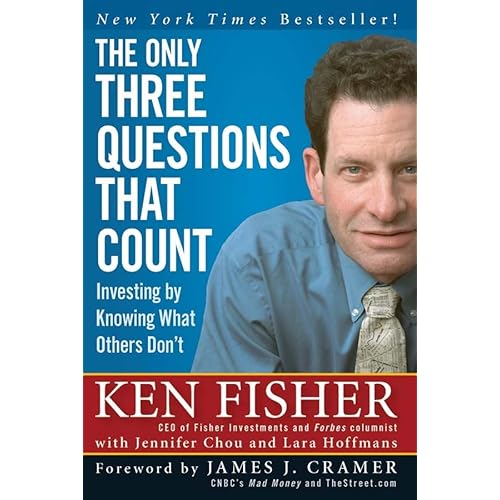
Book Review: The Only Three Questions That Count, by Ken Fisher

Ken Fisher is one of the richest men in America and is a renowned investment manager, following in the footsteps of his - also famous - investor father, Philip Fisher. Each approaches/ed investing with different styles on how to make money.

Philip was a proponent of a concentrated basket of stocks, chosen in relatively few sectors in which one might gather some deeper knowledge over time, and in which relatively exclusive and important information ("scuttlebutt") might be known.

Ken Fisher, the author of this book, on the other hand is more of a top-down, "value-screen" guy, who recommends staying relatively close, asset-class percentage-wise, to a broad-based benchmark. He also recommends a broad portfolio of about 50 stocks. Despite the obvious differences in styles, each style has proven to be successful, respectively, for father and son, and for those who follow. But success only happens for those followers who are willing and able to ask the suitable questions needed to succeed for each investment style.

Ken's style revolves around asking the following three questions:
(1) What do you believe that is actually false?
(2) How can I fathom what others find unfathomable?
(3) What the heck is my brain doing to blindside me now?

Asking the first question calls on you to challenge yourself to find or analyze data to show what you believe is actually false. By uncovering this, we can invest in a different way than we had previously, and in a a different way that many people believe to be true (which is actually false), and, thus, swimming before approaching tide is seen by all, succeed in outperforming the crowd. Catching the early rise of the wave, if you will. Using this question, Ken purports to show that investing when price-earnings ratios (PEs) are high isn't a sign of poor returns to come. This is his big signature statement that challenges a long-held market axiom. More on this in another posting to follow.

The second question calls on you to look for relationships where some (sensible) economic theory can explain what might occur in the future, based on demonstrated relationship to something else that has proven to have some predictive power (correlation). The question can also be stated as "What causes X?".

The final question relates to considering how various behavioural cognitive reasoning flaws might be sabotaging your success as an investor. I have written about many of these factors on my blog before, and these are often highlighted at Abnormal Returns or CXO Advisory, and it's nice to see that the importance of these are becoming more widely written about.

In general, I found the book to be worthwhile, filled with lots of practical tips and thoughts; and the application of the questions cannot but help make you a better, more astute investor over time.

However, I have two issues with the book:

Firstly, I find that Mr. Fisher is very condescending or even downright insulting to some specific people, or classes of people - based on their chosen profession. I find the first to be juvenile and needlessly insulting, while in the second instance he engages in negatively stereotyping a "class" of people, an attribute I frankly have some trouble understanding in a person of his obvious intelligence. In this regard, I think Mr. Fisher should try to display a little more maturity, and tact. As you can probably tell, this behaviour irritated me to a considerable degree.

Secondly, I have some issues with Mr. Fisher purporting to show that high PEs don't denote high market risk. My problem with the posing of his question, rationale and presentation of the "facts" in relation to this will be discussed in a future posting.

Until then, stay safe and use the three questions to consider the investment world in general, and the questions answered in Mr. Fisher's book in particular.


JW

The Confused Capitalist

Tuesday, June 06, 2006

Upside Downside complete review

I've now finished a decent book relating to risk management, Upside Downside: Simple Rules of Risk Management for the Smart Investor. The three main ideas of the book are profiled here (a call for scenario thinking, instead of most-likely case forecasting) here, (know what you own) and here (anticipate "regret" in your investing).

While these three ideas are certainly worthy of consideration for any investor, it's a small book (nothing wrong with that), but it feels "stretched out" with some narrative stories in attempting to hit 200 pages (not quite done, if you exclude the index). So it seems relatively expensive at $29.95.

The book was co-authored by Dr. Ron S. Dembo whom the dustcover describes thusly ...
"... is the founder and former president of Algorithmics Incorporated, and grew it ... to the largest enterprise risk management software company in the world, with ... over half of the world's top banks as clients. He was a professor at Yale ... and holds a number of patents in computational finance. ... In 2003, he was among the first fifty people indducted into the Risk Hall of Fame."
One of the pieces of advice given several times in the book relates to portfolio insurance (and in fact is the concluding sidebar piece), suggesting a good way to achieve this is to invest in a zero (stripped) coupon bond for the face amount of your investable capital, and the balance in some type of stock market investment. In one of the later examples, of a 55 year old looking to the next ten years (i.e. retirement at age 65), takes the investable capital of $200,000, places $130,000 in the strip bond (which has a $200,000 face value at maturity in 10 years), and then uses the other $70,000 to invest in a broad market EFT, which the book suggests could double over the ten years, resulting in a total of $340,000 at retirement. It suggests that this is a well-protected investment.

While that may be the case, this doesn't seem like a particularly good way to invest, given the overall return rate is only 5.3% which isn't a lot better than could be achieved simply by investing the entire amount in a bond which hasn't been stripped. It also suggests that buying futures (puts/calls etc.) is another way to protect a portfolio. Again, while this is true it will generally reduce the rate of return for most portfolios. Insurance always costs money.

All in all, I'd give the book 3.5 stars out of five. Good ideas, but a feeling of having stretched out the book and some examples that don't show particularly strong risk-risk/reward management techniques, in my own opinion.


JW

The Confused Capitalist

Tuesday, May 23, 2006

Anticipate "regret" in your investing, and you'll do better

I've now finished a decent book relating to risk management, Upside Downside: Simple Rules of Risk Management for the Smart Investor. It's a light read and a rather small book - nevertheless, it has some good ideas.

The book makes the point that we need to take more into consideration than just the risk of the investment (or risk of an insufficient return). We need to consider our emotional make up and how we react to a potential loss (or lack of what we consider a sufficient return). The book uses the apparently true life example of a 32 Englishman who sold everything, went to Vegas and bet his entire life savings ($135,000) on the spin of the roulette wheel. Having doubled his money, he left the table and returned to his homeland.

The book points out that although this is a poor investment (odds are less than 50% of doubling your money, due to "00"), he probably considered how much regret he'd have if he never took this chance, against the potential to double his money. His regret would obviously be quite different than a 75 year old betting a similar life savings.

So in addition to considering the actual risk/reward profile of the investment, we need to consider how we feel about each of the possibilities - then to decide whether to invest, based investing an amount that won't exceed the maximum amount of regret we can handle. For some people, regret is the possibility of missing the next Microsoft, while for most investors it involves a perceived loss of capital. Some studies have suggested that the average investor experiences regret at a 2:1 ratio. That is, a loss of 10% produces about twice the regret that a gain of 10% produces happiness.

The main point is, is that if we structure our investments to reduce the possibility of regret, we'll stay in the market longer and increase our chances of long-term success.

All-in-all, a useful book, but it has some limitations, that I'll talk about in a final review, later.


JW

The Confused Capitalist

Tuesday, May 09, 2006

The problem with forecasting - a call for scenario thinking

I'm reading a very interesting book relating to risk management, Upside Downside: Simple Rules of Risk Management for the Smart Investor. It's a light read and a rather small book - nevertheless, it has some good ideas.

In the section discussing why investors should lay out different possible scenarios, rather than simply forecasting, it makes the point that forecasts are too often simply the present extrapolated into the future. It uses some rather famous statements by prominent individuals and organizations to make the point:
  • One day, there will be a telephone in every major city in the US - Alexander Graham Bell, circa 1880.
  • There will never be more than 1,000 cars on Europe's roads, "because that is the limit on the number of chauffeurs available" - Daimler Benz spokesman.
  • "Stocks have reached what looks like a permanently high plateau" - Irving Fisher, professor of economics, Yale University, 1929.
  • "I think there is a world market for maybe five computers" - Thomas Watson, chairman, IBM, 1943.
  • "There is no reason that anyone would want a computer in their home" - Ken Olsen, chairman, Digital Equipment, 1977.
  • "... with over 50 foreign cars already on sale here, the Japanese automobile isn't likely to carve out a big slice of the U.S. market" - Business Week, 1979.
  • "640K ought to be enough for anybody" - Bill Gates, Microsoft, 1981
  • "Television won't be able to hold any market it captures after the first six months. People will get tired of staring at a plywood box every night." - Darryl F. Zanuck, 20th Century Fox, 1946.
or how about this one that I recalled ...
  • Oil: Under the heading "Drowning in Oil", The Economist magazine predicted the world - then with $10 a barrel oil, was heading towards $5 a barrel oil - 1999. Today, forecasts here are quite different.
I hope you got a chuckle out of some of these - but as investors, we need to be diligent in thinking about both risks to our investments, but also potential opportunities that can arise - if the future turns out different from the past - i.e. one does not need a chauffeur to pilot an automobile around.

The book points out that laying out the possibility of a number of different scenarios, requires some thinking about the situation, and considering that differences in the future may arise. By laying out a number of different possibilities - some perhaps even seemingly far-fetched, it allows us to better consider the risk/reward potential of an investment.

By doing so, we avoid the blind reliance on the "most likely" forecast, and to therefore protect ourselves to some degree against other, seemingly obscure, possibilities.

Scenario thinking - worth considering in your own investing.


JW

The Confused Capitalist

Wednesday, April 12, 2006

The Ultimate Question - Customer Relationships and Investing?

A recent book review by Harvey Schachter of The Ultimate Question: Driving Good Profits and True Growth was very interesting.

According to research done by author Fred Reichheld, the vast number of questions asked in relation to customer service aren't all that useful in helping a company to devise metrics that assist in developing profitability.

According to Mr. Reichheld, the only question that's required is this:
How likely is it that you would recommend this company to a friend or colleague?
Respondents are then asked to score this "ultimate question" on a scale of 1 to 10, with ten being the best score.

People rating the company at a nine or ten are considered "promoters" of the company, those at 7 or 8 are considered passive and those below are considered detractors.

The detractors, says Mr. Reichheld,
... may appear profitable, but their criticisms and attitude diminish a company's reputation, discourage new customers, and demotivate employees. They suck the life out of a firm.
The net ratings are developed by subtracting the percentage of detractors who are customers from the percentage of customers who are promoters.

So if a company had 65% promoters as customers, and 30% as detractors, it's net scores would be 35. The highest ranking firms were USAA (a non-public insurance company, catering mostly to military personnel) at 82, Harley Davidson at 81, Costco Wholesale at 79, Amazon.com at 73, eBay at 71, and Apple Computer at 66.

Interestingly, I looked at the stock charts of all the public companies mentioned therein, looking at their ten year records. While Amazon and eBay had only traded for 8 1/2 and 7 1/2 years respectively, one thing seems very clear. This measure is an unbelievable proxy for stock market performance too. The minimum any of these stocks had increased over that period was by a factor of five and went as high as 24x.

The S&P 500 had only doubled over that same period.

The ultimate question: The only one needed for investing too?


JW

The Confused Capitalist

Support this blog and our advertisers: check out the advertised listings.