Tuesday, August 28, 2007

The Upside of Declining Consumer Confidence

The Conference Board reported that consumer confidence dropped in August, giving up nearly all of its July gains.

As the Conference Board reported it ...

"A softening in business conditions and labor market conditions has curbed consumers' confidence this month. In addition, the volatility in financial markets and continued sub-prime housing woes may have played a role in dampening consumers' spirits. But, despite less favorable conditions and in spite of all the recent turmoil, consumers still remain confident. And, current Index levels suggest further economic growth in the months ahead."

(Note: If you're on a blog aggregator, you can visit The Confused Capitalist here (or here: http://confusedcapitalist.blogspot.com/) for additional articles and exclusive content! )

It was reported that this was a prime cause of weakness in the stock market today. Despite notions to the contrary, declining consumer confidence is a good, healthy response to the indebtedness of both the consumer, and the federal government.

Acting otherwise would be a denial of reality. For those soundly in the bullish camp, let's review some facts:
  1. Household debt at unprecedented levels;
  2. A negative household savings rate, something never seen in the midst of an economic expansion;
  3. Federal government debt at the highest levels in recent memory, and still growing;
  4. The continuing trade deficit;
  5. The prospect of a continuing decline in the currency, meaning the Fed has to continue to walk the tightrope between importing inflation on the one hand, and managing the orderly decline of the currency on the other. All the while trying to massage the debacle in the credit markets. An undertaking fraught with short and/or long term risk. Take your pick.

Yes, there's times to be confident, like when things are humming along really well. This isn't one of those times. Then there's the confidence that comes from having been in a place of despair, but when the trends are moving in the right direction. This isn't one of those times either.

Now is a time to make sure you get your own financial house in order.

Start with the basics - your household budget. Review it for unnecessary expenditures. Trim your debt levels, with the most expensive interest rates first. Save some money! Use a high yield account, or find some solid blue-chip stock prospects, or broad-based ETFs. Save (anyone remember the word?) ... save ... save ...

In short, the upside of declining consumer confidence is the ability to not to be a monkey brain - to recognize the potential for trouble (like now), and put some preventative personal actions in place. While the trouble may or may not materialize, planning and acting like this will serve you well in any case. Now isn't the time to be an overconfident consumer - its' the time to be a confident saver!

Don't be blind to reality - open your eyes, look around, think, plan, and act. Are you a monkey?


JW

The Confused Capitalist

Monday, August 27, 2007

Distressed credit buyers opportunity?

They say it's an ill wind that blows nobody good - meaning that even in times of turmoil, there's often someone who's situation is improving.

With that thought in mind, I recalled the recent turmoil in the credit markets, and wondered what companies might benefit from this situation. Leafing through my investment scrapbook, I came across an entry I made some two years ago, suggesting that if the US debt situation imploded, that a beneficiary might be those whose business profile sound like this ...

... provides outsourced receivables management and related services in the United States. It engages in the purchase, collection, and management of portfolios of defaulted consumer receivables. The defaulted consumer receivables are the unpaid obligations of individuals to credit originators, including banks, credit unions, consumer and auto finance companies, and retail merchants. It also provides collateral-location services for credit originators, collections and revenue administration, and audit and debt discovery/recovery services for government entities.
... in other words, those who benefit from a higher default level on any type of consumer debt, since a higher level of delinquency is inevitable, given the negative savings rate of the average American family. Given that, opportunities to load up the balance sheet for these companies with cheaper than ever defaulted debt, at favourable prices, appears better than in recent memory. This could fund very profitable growth for these companies for some years to come.

Some names in this space include:

Portfolio Recovery Associates - PRAA
Encore Capital Group - ECPG
Asta Funding - ASFI
Asset Acceptance Capital - AACC
First City Financial - FCFC

This is an idea worth exploring more for your own portfolio, if you think, as I do, that the ill wind is blowing towards these companies right now.

Note: If you're on a blog aggregator, you can visit The Confused Capitalist here (or here: http://confusedcapitalist.blogspot.com/) for additional articles and exclusive content!


JW

The Confused Capitalist

Thursday, August 23, 2007

Dividend Yield and Payout Yield

Confused Capitalist readers know that I'm a fan of dividends, and consider them to be one of the stronger indicators of a firm who's total return is likely to outperform the broader market into the future.

While the above remains true, one also has to consider the net payout yield, which is the total returned to shareholders by dividends and by the net of share issuance's and re-purchases.

Note: If you're on a blog aggregator, you can visit The Confused Capitalist here (or here: http://confusedcapitalist.blogspot.com/) for additional articles and exclusive content!

There's more and more evidence available to suggest that this is even a better predictor of excess future returns than dividend yield alone. Here are two resources in that regard:

World Beta Posting and PayoutYield.com


JW

The Confused Capitalist

Monday, August 20, 2007

What Greenspan has wrought ... the current market environment

Barry Ritholtz at the Big Picture has exactly nailed the problems that the Fed faces in attempting to manage this market so that things remain orderly. Rather than re-iterate them, I direct you to Barry's posting.

... Pay particular attention to the "while avoiding" part of the posting, and try to think how you can construct your portfolio to take advantage of those very distinct possibilities.

JW

Monday, August 13, 2007

WallSt.Net Podcast

Welcome to everybody from WallSt.net who came over here because of the podcast interview with Dennis Olson (Haven't heard it? Go here; it'll be on their site on Wed. Aug. 15th). Thanks to Dennis and WallSt.net.

This posting is essentially related to some stuff I talked about on the podcast.

Firstly, anyone interested in buying my book can go here.

Secondly, in terms of some of the stuff I talked about in the podcast about why this blog is a bit different than many out there, I mentioned specifically, dividend investing, and long-tail investing. Here's a couple of articles I've posted that kind of give you a bit of the flavor of these topics, here, here and here. And for those who know me and my bent towards value investing, I re-submit this evidence ...

Now, in terms of stuff I specifically recommended (either avoiding, or moving towards) ...


AVOID


Real estate stocks, especially home-builders (see the reasons why, in an article I wrote in my other life) and avoid sub-prime lenders; the first for three to five years; the second for two plus years. Pessimism after that will be prevalent and then would be the time to buy. There's still too much optimism in the market.


BIG BANKS


Conversely, the really big banks are getting tarred with the "sub-prime" brush, which isn't warranted, in my view. Many of these institutions are tremendously strong, with great balance sheets and will easily weather this storm, and perhaps come out of it with better than ever opportunities. They're also paying great dividends right now, and most have raised their dividend recently. This is another sign that they are probably being mis-priced in the market. Some to look at would include:


Of course, those risk-takers might wait for the next mini-plunge which, if it occurs, might raise these yields by another 50 to 100 basis points (i.e. prices might fall by another 10-20%). However, I think they're good enough deals as they sit. Don't delay too long on these folks - "on sale" today!


EMERGING MARKETS
Emerging markets remain a very-long-term theme that investors will be able to successfully play for a decade at least (provided the stocks don't get overpriced). On a purchasing power parity (PPP) basis, these economies currently account for about 20-25% of world trade, yet most conventional financial advisers suggest a 5% weighting or so. This is a serious backward-looking mistake. No investor with a 20 year horizon can afford to take such a light weighting in these strong growth markets.


While the conventional BRIC countries have been bandied about as "the" emerging country investment destinations, other countries also have strong profiles too. A personal favourite of mine remains South Korea, with nearly an "emerged" economy, yet very cheaply priced.

Here's some ways to play the emerging markets theme, via ETFs, in my personal order of preference:


  • Wisdom Tree's ETF - "DEM" - a dividend-weighted emerging market ETF. This ETF should prove more resilient than many emerging market investments during market corrections, while retaining most of the upside during exuberant bull markets.

  • The Claymore Investments ETF - "EEB", which is designed to provide exposure to the BRIC countries, through ADRs. Because ADR issuers tend to be large, liquid companies, this also reduces some risk.

  • The iShares S.Korea ETF, "EWY" - a narrow singly country focussed ETF.

  • The iShares Emerging Market ETF, "EEM" - a very broadly-based emerging market ETF.


AGRICULTURAL COMMODITIES

I think this sector is going to have a huge tailwind going forward, something I've written about here. In later postings, I'll elaborate on how to play this trend.


    Note: If you're on a blog aggregator, you can visit The Confused Capitalist here (or here: http://confusedcapitalist.blogspot.com/) for additional articles and exclusive content!


    INFRASTRUCTURE BUILD OUT

    This is tied in with several other trends, including the re-building of the industrialized world's infrastructure to make it greener (using mass transit for instance, to replace the crappy aging stock of roads and bridges).

    Also, the infrastructure build out in the emerging markets is something that's going to continue to occur during the next several decades. For instance, the Chinese GDP per head is about 1/4 of what it is in the US (on a PPP basis), while in India it's about 1/10 (PPP basis). These economies will also obviously be building out their infrastructure. Accordingly, I like some of the very large manufacturers, like General Electric ("GE") & Siemens AG ("SI"), but I especially like the engineering firms that'll obviously be beneficiaries of the design and over-sight work needed here. Some names in this sector include:


    Well, that's about all for right now - if you're new to the site, feel free to poke around. If you're a regular, thanks for coming by.


    JW

    The Confused Capitalist

    Thursday, August 09, 2007

    Car makers: Why can't they understand it's all about long-term quality?

    I see that the former embattled head of Home Depot, Robert Nardelli, has been named head of newly-private Chrysler Corp.

    According to one report, Mr. Nardelli wants to move faster on a turnaround plan announced back in February.

    I know this suggestion may come as a stunning revelation to those in the so-called "Big Three" automakers, but given that Mr. Nardelli is new to the industry, I thought I'd let him know what the problem is.

    Some 40 years after the "invasion" of the Asian car makers, the reason for the decline in the Big Three market share:


    1. isn't because they lack some fine-looking vehicles;


    2. isn't because the vehicles cost too much money (because they usually cost less than the "Japanese" vehicles);


    3. isn't because they don't win some JD Power "initial quality awards";


    4. isn't because the American or Canadian worker is lazy or no good (lots of "Japanese" vehicles are made in the USA and Canada).

    No, the reason for the decline isn't any of those reasons - it's because of the crappy long-term quality and reliability issues. People are tired of buying junk. I mean when you hear (as I have) of five, yes, five, automatic transmissions in a Chrysler mini-van (yes, driven by the sedate mini-van crowd) frying before the warranty expires, you've got to ask yourself, why? Why would I ever buy this junk again?


    Note: If you're on a blog aggregator, you can visit The Confused Capitalist here (or here: http://confusedcapitalist.blogspot.com/) for additional articles and exclusive content!


    So with the aforementioned in mind, I've prepared a list of the top three tasks for Mr. N over the next five years:


    1. Improve the long-term quality and reliability of Chrysler products as much as possible in the next 1-2 years;


    2. Seriously improve the long-term quality and reliability of Chrysler products as much as possible in the next 3-4 years;


    3. Improve the long-term quality and reliability of Chrysler products to begin truly competing with the best "Asian" vehicles over the next 5-10 years;
    There - that's it - the "magic" formula for success - but why do I feel that this is just futile even mentioning it?


    JW

    The Confused Capitalist

    Wednesday, July 25, 2007

    Be vwery careful, vwery, wwery careful ... more on real estate and subprime time

    As Elmer Fudd used to say ... be vwery careful ...

    About investing in real estate or the subprime mortgage market. You know, just like NASDAQ circa 2000, it took speculators a long time to be convinced that, yes, things were really as bad as they seemed. And that was in the technology stock market, with its hyper-frenetic pace.

    Image how long it'll take for *everyone* involved in the real estate market to realize the same. Today, it's just the subprime lenders who are depressed. Tomorrow it's the prime lenders ... and sometime thereafter ... by the real estate speculator ... then to be followed by the real estate investor ... to be finally ... finally ... followed by the deep-pocketed developer/builder.
    Note: If you're on a blog aggregator, you can visit The Confused Capitalist here (or here: http://confusedcapitalist.blogspot.com/) for additional articles and exclusive content!
    When even all those deep-pocketed guys can think about is surviving, then it's time to buy. And only then.

    As I suggested one year ago, real estate debacles of this nature (i.e. free money from Greenspan) will take a long, long, time to boil off - expect market declines in coastal regions to continue for years. In farm country, however, things will be vastly different for several reasons.

    Sit tight investors ... patience is now key if you're thinking of sub-prime investing (wait two years), or real estate developer/builder investing (wait three to five years). Yes, it takes a long time for this to unwind and people to become truly depressed about the future ...


    JW

    The Confused Capitalist

    Friday, July 20, 2007

    Sub-Prime Mortgage Mess: Did It take a genius?

    I'm often amazed at how really smart people can get caught up in the crowd, along with their friends and peers. Caught up in the Extraordinary Popular Delusions and Madness of Crowds, even really smart people have trouble rationalizing their behaviours later, in a way that doesn't sound like they themselves still haven't figured out what happened to them.

    In this category then, perhaps I should apply for a job as the head of GE, or perhaps GE Capital, or perhaps as the GE Chief Financial Officer (CFO). GE has recently decided to exit the sub-prime mortgage business, due to its obvious problems and potential for more. In reading one account of the reason they were exiting, GE CFO Keith Sherin said this ...

    "In the first quarter we said we were committed to the business and we were. Based on the changes we saw, we made the decision to exit the business. I think it was a smart move."

    Note: If you're on a blog aggregator, you can visit The Confused Capitalist here (or here: http://confusedcapitalist.blogspot.com/) for additional articles and exclusive content!

    Back in March 2006 (just after this blog started), I posted on the housing market and the potential for sub-prime loans to wreck havoc on the bottom line, suggesting that ...


    "Having seen the tall-headed gnomes in my own financial field previously lend to extreme ratios in the dying days of a real estate upswing, I thought they'd have figured out that lending like that at the end of a long cycle, isn't very good for the bottom line. "

    I guess if Keith Sherin didn't realize it wasn't a very good business to be in at the top of a real estate cycle (like about a year-and-half earlier, when they could have sold these assets for a lot more money, instead of taking a charge to get out of the business), then I'm a lot wiser than he is.
    Hmmm, I wonder what the pay is in his job? Mr. Immelt let's talk stock options ... how many can I get?


    JW

    The Confused Capitalist

    Saturday, July 07, 2007

    Two worthy newcomers to the financial bloggers world ...

    There's two new blogs out there that I'd like to draw your attention to. Two blogs that might battle for your attention in the future.

    The first is a blog written by a TOC, Deborah, from near my area, in rainy Vancouver, BC. She writes a blog called Making Sense of My World.

    It's an exceptionally detailed look into the world of mining stocks, primarily, but she occasionally touches on other financial subjects as well. It's clear to any reader, including one like myself who has little understanding of mining stocks, that she has dived in deep enough to figure out "What's Up".

    With her, "making sense of my [her] world", she's helped me understand the mining world a bit more. I highly recommend a visit to "Deb's World". See also the new link on my blogroll.

    Note: If you're on a blog aggregator, you can visit The Confused Capitalist here for additional articles and exclusive content!

    The second blog I'd like to draw your attention to is one written by Eric Fox, the Market Prognosticator. Eric recently emailed me and asked me if I'd take a look around his blog. I like someone who asks for what they want, and Eric did that. I was very pleasantly surprised when I read several of his articles, and liked his edgy tone and slant on things. I read several of the articles and enjoyed them thoroughly. An excerpt from ... The Most Terrifying Thing I Have Read in My Life ...


    I get an e-mail every morning with a recap of what is going in the market. Most of the time the articles are something I have read somewhere else or I am not interested in them. Today was different. The headline was enticing. It read: How do you pay off your home mortgage in a few years or less? Learn to use hedged ...

    The last word was left off but it was not rocket science to guess that the missing word was "futures." Oh this was going to be fun. When I clicked on the link it was even better than I thought. It read: How do you pay off your home mortgage in a few years or less? Learn to use hedged futures with options and arbitrageur strategy.

    Well sure why not? There's nothing wrong with 80 million homeowners entering the futures market. This might even solve the sub prime lending mess. People who can't even read a mortgage note trading futures and options.


    Eric goes on in the article ... rather amusingly, I might add. I recommend his blog for those looking for a bit of insight and spicy writing.

    Find also the link to Eric's blog in my blog roll to the right. Well, hope you all had a safe and enjoyable Independence Day. Bye for now ...


    JW

    The Confused Capitalist

    Saturday, June 30, 2007

    Raising the Median: Computer Hardware and Software

    Image Source: MadAsHellClub.Net

    I'm mad as hell and not going to take it any more! (Well, not really, but I am more than a bit disturbed [ask anyone who knows me] :-)

    In any case, I've kind of had it with computer hardware and software makers who don't promote better ways to do things and perpetuate the mediocre or inferior.

    One obvious example of this is the present keyboard you are probably typing on (just as I am). It's antiquated and inferior in two very obvious ways:
    • Firstly, the actual locale of the letters on the QWERTY keyboard layout, is a relatively slow method to type (created to slow typing down, so 18th century typewriters wouldn't jam). Because of this crappy letter layout, Repetitive Strain Injury (RSI) is epidemic among those regularly using keyboards. Additionally, it's a slow way to type, compared to several more modern alternatives, particularly a fairly new one that takes advantage of prior Qwerty training, while minimizing re-training time compared to using a Dvorak keyboard.

    • Secondly, the flat keyboard, with its offset letters, also contributes to RSI, to a higher error rate, and was something that was designed for the actual mechanics of a typewriter, never for the human being. That the computer makers chose to perpetuate this too when manufacturing computer keyboards, is even more unbelievable.

    So, in relation to item #1 above, a Dvorak layout (which many of you may have heard about) is far superior to the standard Qwerty layout and results in superior speed (the world's fastest typist used a Dvorak layout), and less RSI. However, the problem is, is that almost every key (33 of them) is recast elsewhere on the board, with many also jumping between hands.

    This results in a steep time-consuming learning curve, and many people give up because of this (as I did), even though you can easily reconfigure your keyboard through a software add-on (go to Microsoft, here, if interested). This is probably the reason that the Dvorak never caught on - the very steep learning curve.

    No, based on this idea though, others have been at work to recast the keyboard letters, using the lessons of Dvorak, but minimizing extraneous key movement from the Qwerty standard, where gains are minimal. In the case of the Colemak layout (moves only 17 keys, and minimal moved to the "other" hand), this results in, reportedly, much smaller learning curve, with similar speed and ergonomic gains to Dvorak.

    It is now the third-most popular English language layout, and is gaining converts every day. More information, including a downloadable program to convert your existing keyboard to this superior letter layout is located at Colemak.com. I hope to download and convert to this layout. I'll report out on this from time to time.

    (Note: If you're on a blog aggregator, you can visit The Confused Capitalist here or here [http://confusedcapitalist.blogspot.com] for additional articles and exclusive content!)

    Keyboard layout comparisons (click to enlarge any of the below):

    QWERTY (The old-fashioned, crappy, standard)


    DVORAK (A better keyboard, that never caught on, probably in part due to the learning curve - look how many keys not only shift position, but from one hand to the other).
    COLEMAK (With some luck, this will become the defacto standard, particularly with young people. Note how many Qwerty positions are retained, because moving them doesn't create significant improvement and moving them needlessly creates more difficulty in learning a new board layout for old-timers, like me)


    So if you're looking to be a faster typist, to alleviate your own RSI, and just generally to make the world a better place, head on over the Colemak.com for a free download to covert your keyboard. OK, that's Rant #1 over. Let's move onto Rant #2.

    Secondly, the actual keyboard itself sucks! The hardware makers should have corrected the obvious deficiencies in this, once there was no mechanical reason to retain the "offset" configuration. It results in missed keys, too much finger stretching, and incorrect wrist position, among other problems. The Confused Capitalist has been researching this issue however, reading reviews on the net, and believes to have found a superior board.

    While some boards split and twist the keyboard (like the Microsoft Ergonomic that I use at work) which solves part of the problem, it still leaves a large portion of the ergonomics unfixed. However, a newer board, called the SmartBoard, solves most of these problems and adds several other key fixes, as well. The SmartBoard is available from datadesktech.com - see image below.
    Finally, rant #3, isn't really a rant, but more of an eye opener. Many people use the Microsoft Office programs without believing there's any real alternatives out there. Well, Open Office has been picking up speed lately, and similar in some ways to Linux, converts. It is a free, volunteer-maintained open source program, providing an array of office suite type products. By all accounts on the internet, the latest release is continuing to improve and now rivals most of the Microsoft suite for utility, versatility, sophistication, stability, etc.

    In some cases, some of the programs are reported as superior, with the most notable complaints being for the Power Point equivalent "Impress" still not up to the Microsoft standard, while the spreadsheet program "Calc" isn't - for sophisticated users - as good as Excel. However, huge strides have reportedly been made over the prior release. According to my research, many users are reporting that they prefer the Open Office word processor. You can go to OpenOffice.org to download this FREE program. So, even if a couple of the programs aren't quite there yet, it's not hard to think they will be soon.
    Oh, and did I mention that Open Office can both properly read and save back into a Microsoft format? So my only question would be - unless you have very sophisticated spreadsheet or presentation needs - why on earth would you spend the bucks to upgrade to the latest Microsoft suite?

    By the way, many of you might note the label "Global Warming" below, and wonder how this bloggering possibly ties in with that theme. It's simple really - any improvement in efficiency offers the possibility of turning off the computer sooner, and therefore reduces power consumption. Further, less RSI means fewer trips to the doctor. Ergo, less greenhouse gas emissions.

    Secondly, using Open Office, an open source document, means that you don't - perhaps - have to work quite as much, since you don't need to pay for this particular type of product. Ergo, the potential exists for a couple of less trips to work every other year. Times millions of workers = less greenhouse gas emissions.

    Perhaps not obvious connections, but ones which can, and I believe, do, exist.

    Well, that's it for now - I have all of these links on the right hand side of my blog, under the title "Computer Stuff". I hope you are able to use this to improve your own life - to "raise the median".


    JW

    The Confused Capitalist

    Monday, June 18, 2007

    Food Shortages and Food Inflation: Malthusian future?

    Image: Food skyscraper of the future?


    Although Malthus has long been laughed at by those convinced that technology will solve any problem, in any finite system, one must reach some sort of system limits, as demand for a resource outstrips that method of producing it.

    Although it may happen for slightly different reasons than postulated under the Malthusian catastrophe scenario, it appears this is starting to happen with food and will soon be found in a supermarket near you, via food inflation.

    There is a confluence of forces that make serious food inflation, at the minimum, particularly likely over the next five to ten years:

    Factor number one is the bee die back, and the effect it is likely to have on food prices over the next few years, as yields are curtailed due to a reduction in pollination. One economist figures that this will put over $15 Billion in North American crops at risk, all adding to potential for food inflation.

    Factor number two is the growing wealth of emerging markets, and their propensity to emulate a western-style meat-heavy type diet, as wealth grows. This puts increased pressure on grain crops in particular, as it takes anywhere from about 5-20 pounds of grain to produce a single pound of meat. As large populations in China and India move further away from vegetarian or semi-vegetarian type diets, this strains limited global food stores even further, adding to food inflation.

    Note: If you're on a blog aggregator, you can visit the Confused Capitalist here or here (http://confusedcapitalist.blogspot.com/) for additional articles and exclusive content!

    Factor number three is the changing climate. Scientists have long known that food yields can come under pressure in at least two ways as global temperatures climb. Firstly, at higher temperatures, some plants - despite ample water - either cease production, or lower production. In either case, yields are lowered. Secondly, changing climate results in more extreme weather, including droughts, hurricanes, extreme rainfall etc. Total yields are obviously reduced under those circumstances too. (Alt citation, PDF)

    This was recently brought home to me by an Australian cousin, who laments the drought his country has been going through for some time: he tells of kids in some parts of the country now entering high school, who have never seen rain.

    Factor number four is the number of lunatic politicians, in their bid to never offend anyone while running for office, avoid telling the truth about ethanol from corn: it's doubtful it actually produces any additional (net) energy after it's energy inputs are calculated, AND it's going to (in fact, already has) further increased food costs.

    I watched a shameful 20/20 series where every single presidential candidate at a town-hall type meeting claimed that ethanol was part of the solution, rather than more likely to contribute to an even bigger problem. Whatever happened to a "give 'em hell", Harry Truman style candidate? Are they all too meek, too bland, and too gutless for even one of them to stand up and tell the truth? And the truth is, is that ethanol, bio-diesel, or any other fuel made from food sources is only going to add to food inflation, possibly to serious food inflation.

    One article also discusses many of these issues and interestingly points out that China, to feed itself, should be adding a quantity of arable land equal to Maine, every year. Instead, it has lost that amount every year over the past decade. Another article, in the respected Popular Science magazine, discusses these looming food questions.

    There are, of course, always those head cases who are convinced that technology will solve any problem. However, increasing technological solutions have coincided with increased energy demands and, in a global warming world, one of these trends most likely has to give.

    I read a recent article suggesting that food skyscrapers may be the way of the future - but these won't be coming any time soon and, due to costs, may end up with all those other strange Popular Science ideas that never see the light of day due to cost or technical issues that can't reasonably be overcome.

    The Confused Capitalist will provide some practical and investment advice on how to deal with this over the coming while.

    More reading sources:


    JW

    The Confused Capitalist

    Sunday, June 17, 2007

    Beating the S&P 500

    Back in early 2006, The Confused Capitalist suggested a low maintenance model portfolio that I felt would outperform the S&P500 over the next five years or so. The portfolio was based on certain themes, some of which are ones which have generally proven to outperform over longer periods of time, such as buying value positions and small companies.

    Additionally, I felt that commodities and emerging markets would continue to benefit from the world situation, and that the US dollar would continue to be under pressure - thereby adding to investments denominated in something other than US$. I suggested positions in a total of six ETFs, at values of 7.5% to 25% of the portfolio, with most around the 20% range.

    To compare, we suggested a suitable tracking comparison would be the S&P500, as represented by the "SPY" ETF which was then priced at $131.47. It closed Friday June 15, 2007 at $153.07, a gain of 16.4%, which is pretty good. Add in dividends of roughly 2% or so, and the total gain is about 18.4%. If you'd gotten this, you would have beaten about 80% of the mutual funds out there, using traditional five year horizons as a guide (only 1 in 5 mutual funds beats the index, when the period is five years or so).

    Sidebar note: If you're on a blog aggregator, you can visit The Confused Capitalist here (or here: http://confusedcapitalist.blogspot.com/) for additional articles and exclusive content!

    Let's see how our own simple ETF-based portfolio, which looks like this, performed:

    • 20% weighting to a broad-based international ETF - EFV - $64.91 - ishares product tracks the MSCI EAFE Value Index, which tracks European, Australian, and Far Eastern markets. This ETF closed at $78.92 on Friday June 15, 2007, for a 21.6% gain, plus dividends. Advantage: The Confused Capitalist.

    • 20% weighting to small company - IWN - $74.99 - ishares product tracks the Russell 2000 Value Index (US small cap). This ETF closed at $85.11 on Friday June 15, 2007, for a 13.5% gain, plus dividends. Advantage: The S&P500.

    • 25% weighting to emerging markets - EEM - $105.45 - a broadly-based (for emerging markets) ishares product tracks the MSCI Emerging Markets Index. This ETF closed at $132.42 on Friday June 15, 2007, for a 25.6% gain, plus dividends. Advantage: The Confused Capitalist.

    • 20% weighting to the value portion of the S&P 500 - IVE - $70.62 - an ishares product tracking the value portion of the S&P500. This ETF closed at $83.78 on Friday June 15, 2007, for an 18.6% gain, plus dividends. Advantage: The Confused Capitalist.

    • 15% Own Ideas (in this case, my belief that commodity-oriented countries will do well for the next five to ten years). I'd equally weight a Canadian ETF (EWC) - $24.86 - and a Brazilian ETF (EWZ) - $44.25. The EWC closed at $30.58, for a 23.0% gain, while the EWZ closed at $62.66, for a 41.6% gain. Advantage both: The Confused Capitalist.

    These weightings result in a total gain of 22.0%, plus dividends which, in this case, would add about another 1.5%, so the total would be about 23.5%, versus the 18.4% all in of the SPY ETF.

    So not only did the Confused Capitalist beat the S&P500 ETF by five percentage points in just over a year, it did so in 5 of the 6 ETFs selected, showing broadly-based outperformance. The Confused Capitalist feels comfortable continuing to hold these same positions and original weightings going forward over the next year or so, and will check back in 2008 to compare relative performance.

    I hope to continue to show that a low-maintenance portfolio, with modest thought given to what the future might look like, will continue to be able to outperform static indices. Those wishing to view some similar simple portfolios felt to have an excellent change to outperform the S&P500, should go here, here and here.

    With these increases in value, the weightings have changed slightly going forward, but not enough to warrant a re-balancing. These weightings are now:
    • EFV - 20.0%
    • IWN - 18.6%
    • EEM - 25.7%
    • IVE - 19.4%
    • EWC - 7.6%
    • EWZ - 8.7%
    June 18 2007. 12:10PM Pacific time. Correction made to the EEM discussion bullet, which misstated (understated) the current price and percentage increase. Ah, the dangers of using the "cut and paste" function!


    JW

    The Confused Capitalist

      Saturday, May 05, 2007

      Next Fed Move will be up, not down! Inflation not quelled yet.

      After an extended break to see my brother get married in Los Angeles, including a visit down to Sea World and Disneyland, some time away for training, and just a general break, the Confused Capitalist is back.

      Note: If you're on a blog aggregator, you can visit The Confused Capitalist here for additional articles and exclusive content!

      The Confused Capitalist has been busy reading the tea leaves, as well as a very interesting book on the process of "intuitive" thinking, and in the Blink of an eye, realized that the Fed will have to move interest rates up, rather than down.

      Inflation is not yet quashed, and inflation around the world also appears to be moving towards the upside. A declining US currency won't help things either, as inflation will be "imported" in addition to domestic pressures. The Fed will most likely begin to move rates up in nine to 15 months, and it won't just be 25 basis points until they stop. Where they will stop, I'm not certain, but it will be at least 50 basis before they pause again, but possibly as high as 200 basis points, looking out over the next 24-36 months.

      Well, that's my tea leaves reading for this quarter. These days sure feel like the 1970s in many ways.


      JW

      The Confused Capitalist

      Monday, April 09, 2007

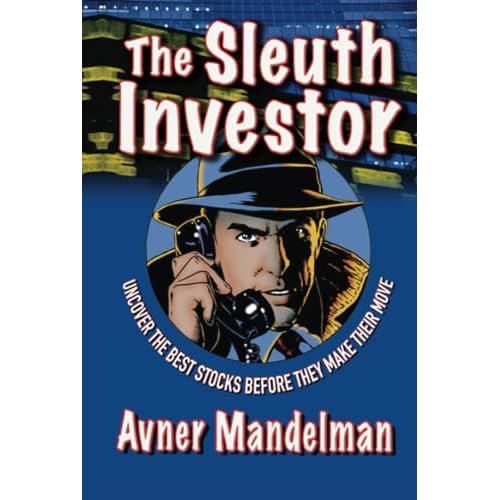
      Book Review: The Sleuth Investor by Avner Mandelman

      This is a book which every serious investor must acquire. A book which can help level the field between the large institutional investor, with all the attendant advantages, and the small investor like me.

      While I own some 25+ investment books, including classics such as "Security Analysis", "One Up On Wall Street", and "Common Stocks and Uncommon Profits", I have to say that I think this book will prove to be the most personally enriching.

      I could just tell right from the cover that this book, The Sleuth Investor, was going to be different from almost every investment book I've every read. Instead of a picture of Bulls or Bears, The Author, Dollars Floating in the Sky, or a Stock Exchange Building, instead there's a picture of what appears to be a private detective or, perhaps, a field operative. As I surmised from the cover, the book didn't disappoint.

      And the dust cover picture cuts to the heart of the difference between this book and all the other investments books I've read. The difference between receiving second hand, "academic" information of stocks (eg annual and quarterly reports, etc.) or gathering that publicly available information, PLUS quality information directly from the field.

      Note: If you're on a blog aggregator, you can visit the Confused Capitalist here for additional articles and exclusive content!

      The author, Avner Mandelman, president and CEO of investment firm Giraffe Capital, tells you exactly how to sleuth out investment opportunities "in the field". He gives direct examples of what, who, how and when. This is not a book full of numbers and ratios; Mr. Mandelman knows full well that the investment world is full of these, yet the number of investors able to outperform the market is very few indeed.

      In this book, he shows you how to both lower your investment risk profile, all the while increasing your odds of batting not just one, but numerous, investment home runs. While some investing books, such as Ken Fisher's "The Only Three Questions That Count: Investing by Knowing What Others Don't" state the importance of acquiring exclusive or near exclusive information, his book doesn't actually show you how to achieve that, since it only provides some further academic tools to suggest whether you might know something others might not know. On the other hand, if you apply Mr. Mandelman's suggested techniques, you'll know when you know something others don't when you are finished "sleuthing" a stock story.

      I certainly haven't read any like it before, although there's hints of "One Up On Wall Street", by Peter Lynch here and there, and some visible heritage to "Common Stocks and Uncommon Profits", by Phillip A. Fisher. There's also some obvious lineage to Warren Buffett's ideas as well.

      The book is a great read as well; it was the first investment book I've read since "On Up On Wall Street" by Peter Lynch that I when read it in bed, it was because it was so interesting, rather than because I intended as use it as a non-prescription sleep aid.

      Canadian readers who've followed the business community here for a dozen years or so, will also especially savour a couple of the tales of "investment sleuths" from a couple of the high profile business stories and people here.

      In one example, the "Z-Plat" story (almost certainly the Bre-X fraud) a sleuthing pension-fund manager saved his company a small fortune from physical sleuthing of a mining company's claim, and later turned that same information into a small personal fortune.

      In another story, "Chipperware", Mr. Mandelman explains how he was able to turn a tidbit of public information about a piece of a one-of-a-kind designer clothing into a small fortune. One never knows of course, but many of the facts here appear to parallel some known public information about the wife of Corel Corporation's founder (Dr. Michael Cowpland), the flamboyant Marlene Cowpland, and an extremely expensive dress she wore to a gala.

      Yes, as you read the stories of "Chipperware" and Z-Plat, be aware that these tales are almost certainly real business events as well.

      In summary, this is an investment book that meets its dust cover promises. I cannot stress highly enough the importance of making this soon-to-be investment classic part of your permanent investment library.


      JW

      The Confused Capitalist

      Curious Capitalist? Non! Canadian Capitalist? Non!

      Did you take a wrong turn? An internet storm wash to the wrong shores?

      Just in case you arrived here looking for the Curious Capitalist, he's not here! He - Justin Fox of Time magazine - joined the blogosphere many, many, months after I did. An interesting read from time to time. Here's his inaugural blog posting.

      Note: If you're on a blog aggregator, you can visit The Confused Capitalist here for additional articles and exclusive content!

      Nor am I the Canadian Capitalist, who was here, but is now here. He appears to have been blogging since late 2004, about a year and a half earlier than me.

      No, if you're here, you've arrived at the Confused Capitalist. Feel free to poke around the site, and let me know if you particularly enjoyed something, or were particularly annoyed by something.


      JW

      The Confused Capitalist

      Friday, April 06, 2007

      $124.93! Thank you!

      I received my first cheque from Google for the ads running with my blog. Of course it's primarily based on volume of click throughs.

      After 180 articles, and hundreds of hours spent maintaining and researching articles that ended up in this blog, I got my cheque of $124.93. Which ain't bad for a hobby I'd do for free; lucrative it's not, but it's nice to be able to take the Mrs. Confused Capitalist out for a nice dinner (or, as she's want to do, pay a couple of bills with it).

      Note: If you're on a blog aggregator, you can visit The Confused Capitalist here for additional articles and exclusive content!

      Luckily, I received a speeding ticket lately that'll nicely gobble up that cheque. The ticket cost? $124 even. Which leaves me trying to figure out what to do with the 93 cents.

      In any case, thanks to my readers, and thanks for those who click through once in a while!

      Oh, by the way, I recently received a copy of the newly-minted book "The Sleuth Investor" by the excellent Avner Mandelman. I am enjoying the book immensely and will provide a review of it very soon. It reads very well and provides considerable investing insight.


      JW

      The Confused Capitalist

      Thursday, March 29, 2007

      Are Growth Stock Prices Reflecting a Cheery Consensus?

      In one of his chairman's letters, Warren Buffett once stated that ...

      "The future is never clear, you pay a very high price in the stock market for a cheery consensus."

      I just looked at the 10 year returns of the Russell 1000 Value Index, and the Russell 1000 Growth Index.

      Frightening, the cost of a cheery consensus, particularly those orienting towards the growth side of the equation.

      Sidebar note: If you're on a blog aggregator, you can visit The Confused Capitalist here for additional articles and exclusive content!

      The difference in the current valuation metrics on the two indices are significant, scary, and points to, may I suggest, more of the same looking forward.


      JW

      The Confused Capitalist

      Thursday, March 22, 2007

      A superior index arises: just a better mousetrap

      This can either be read as a stand-alone posting relating to why fundamental indexing is a better way to go than tracking a conventional index, or it can also be read as part two of two of a book review of "The Little Book of Common Sense Investing", by John Bogle.

      As relayed in part one of my review, I found the evidence presented by Mr. Bogle to be almost overwhelming that investing in a low-cost index fund was virtually the only way for the average equity investor to outperform the broad market, like the S&P 500, over time. A very good method as the book clearly details.

      However, in the book (chapters 12, 14, 15 and 16), Mr. Bogle suggests that some of the new fundamental indices (e.g. FTSE RAFI) aren't going to stand up to the test of time, as market capitalization-weighted indices (such as the S&P 500) have. He intimates that, having seen various "better mousetraps" come and go, so too will fundamental indexing (which back-testing shows has outperformed a cap-weighted by nearly 2% annually, a huge margin). This is essentially, he claims, just another method to part the foolish from their prospect of future returns.

      He denigrates the back-testing of these fundamental indices as if that was somehow undesirable. I personally fail to see the difference between the back-testing done there, and Mr. Bogle's own back-testing that led him to the conclusion that low-cost index investing was going to beat the then conventional mutual fund of the day (an advantage that has continued to hold up to this day).

      Mr. Bogle fairly asks the question of why these fundamental factors (fundamental factors are centered on accounting items, like book value, dividends paid [or dividend growth rates], earnings, revenues, etc.) have not been properly exploited by stock markets in the past? While there have been tons of academic studies pointing out that a stock-picking method using virtually any of the aforementioned factors as a major stock-picking factor would have outperformed the broader market, that still doesn't really answer the question.

      The question is best answered by examining behavioural research. In other words, it has to do with the emotional nature of people, something that even mutual fund managers are subject to, as clearly evidenced by the typical 100% turnover on the conventional mutual fund. Certainly, they also appear to be "taken in" by a "good story", as much as anyone. For more insight on this issue, see the following (warning: large pdf file) commentary, Seven Sins of Fund Management. In short, the problem is, my dear Mr. Bogle, interference from human beings.

      Just as Mr. Bogle was then a pioneer of the day, by exploiting something seemingly obvious and mundane (i.e. 1. costs matter and 2. don't get trapped by "the story") it seems hard to believe that no one can build a method for a relatively sustainable advantage over a conventional index. In the future, the building of these fundamental indices today will probably be seen as something that should have occurred much earlier, given their obvious superiority.

      But getting back to the business at hand, if, as alleged by Mr. Bogle early in the book, that long-term investment returns more or less parallel the returns of the stock market of the underlying businesses, doesn't it make sense to construct an index which actually gives weighting to those factors, as opposed to the more temporary and whimsical valuations imposed by market activity?

      Doesn't it make sense to try and limit or exclude the "speculative" return (positive and negative) he discusses, which is, essentially, the contribution (deduction) to (from) short-term returns from stocks becoming over (under) priced? Fundamental indices attempt to do that: exclude the most-egregiously over-priced stocks, by fundamentally examining the books of each company. Conversely, these indices also include more of the relatively undervalued companies. That these indices might succeed over the longer-term would be due to the rules-based inclusion of companies into the index. A fairly simple, but effective, way of eliminating or minimizing poor investment decisions: rules!

      After a time, I think Vanguard, Bogle, and other indexers will recognize that these are superior indices. Then, more index funds will be created to track them. Because the basis of inclusion into these indices are the actual economic activity of the companies themselves, rather than the more capricious valuations assigned by the market activity of the moment, they can finally answer a question Bogle poses in the book: How to know which companies are over-valued in a conventional index? Effectively, the books of the companies themselves answer that question.

      In the end, an index that examines the fundamentals of companies in some manner simply has to be better than one which only considers the temporary selling prices of their stocks. Vanguard and others will finally realize this, and bring the same ruthlessness to cutting costs that they did to tracking the S&P 500, for instance.

      Whether these indices will continue to significantly outperform conventional capitalization-weighted indices starting twenty years from now, the answer is "probably far less" than current back-testing has shown was available. As the "rise of the machine" eliminates emotional interference (1, 2) from making "on mass" good investing decisions, these market inefficiencies will be exploited such that they will disappear over time. And while the costs are currently slightly higher for these ETFs (about 0.5% annually) than an extreme low-cost conventional index-tracker (about 0.19%), the cost/benefit equation seems to be worth it (i.e. you pay an extra 0.3% or so, to get about 2% more).

      In the interim though, as these inefficiencies are finally properly captured over the next decade or two, it's possible that excess returns will even exceed that shown in back-testing. And any advantage that is likely to persist over ten to twenty years isn't something to be ignored, in my view.

      Anyone with a broadband connection and who wants to really understand the multitude of reasons why these are superior indexes, are suggested to go to these two (one, two) video presentations, by Rob Arnett of Research Affiliates.


      JW

      The Confused Capitalist

      Monday, March 19, 2007

      Editorial: Why a Responsible Fed Won't Lower Rates Anytime Soon.

      Notwithstanding the perceived subprime "crisis", a responsible Fed can't lower rates anytime soon. Why?

      Because the consumer is finally being told, in no uncertain terms, to smarten up, stop spending more money than you have, and save a little bit. With this message, (and a puncturing of the home-ATM cash-machine) inflation will finally begin to get tamed.

      Any loosening of the money supply at this point, while mitigating the short-term damage that will soon become evident in bloated housing markets, will only move that day of reckoning into the future. A future time which which would then have bleaker, more uncertain and more unstable fundamentals, from which to try making essentially the same maneuver.

      No, dear readers, this is the medicine that great-great-grandmother used to force down great-grandmother's throat: a nasty-smelling, foul-tasting, herbal concoction that nearly gagged the dear girl. But medicine that helped the patient recover sooner, and more robustly.

      To lower interest rates at this time is the equivalent of turning up the heat in the house, so that the feverish patient may feel comfortable. Foolish. Understandable to some, with the child whining so loudly but, all the same, foolish.

      And a responsible Fed just won't do that.


      JW

      The Confused Capitalist

      Saturday, March 17, 2007

      S&P 500 Future Returns

      Readers may wish to take the investment poll located on the right hand side of the blog which asks what you expect the S&P 500 rate of return to be over the next 10 years.

      Thanks to Geoff Gannon of Gannon on Investing for providing this poll.

      JW
      The Confused Capitalist