Showing posts with label Avner Mandelman. Show all posts

Sunday, January 20, 2008

Cleaning up behind "Easy Al" (Greenspan)

If the economy was a ship, then Easy Al guided the world's largest economy within spitting distance of the shoals. Now, everybody else has to try and make sure that it doesn't crash into those shores, wrecking secondary havoc elsewhere.

The Bank of Canada is widely expected to lower its interest rate at its next meeting on January 22, in response to the slowing US economy and liquidity issues. Because Canada's largest export market is softening, having our currency float through the roof would hurt many Ontario-based manufacturers who count on this market. So we too are in the position of having to lower our interest rates, even though this is against the other relatively strong fundamentals elsewhere in the country. This, undoubtedly, will cause trouble further down the road, as in the stagflation that money manager and financial columnist Avner Mandelmann says has begun to visit its plague on the US.

While it's unfortunate that this will happen, viewed through the lens of alternative realities, which could include a depression, suffering through 10 years of stagflation seems infinitely better.

For Canada, the picture is different. Public finances are on the soundest footing in a generation, and all attempts should be made to maintain that. Accepting that American troubles are real but different, we should not follow the same asset inflation mistakes made there, by allowing our credit to become too cheap. Policy-makers and central bankers must put their heads together to make humus out of manure, so that Canada can take advantage of this situation, and not blindly follow the Americans down the manure-laden stagflation trail.

Perhaps first among these actions is lowering the cost of credit at a very slow pace, to a far lesser degree than that seen in the US. Secondly, as the cost of credit is lowered once again, perhaps accelerating our own national debt repayments would give us additional flexibility down the road.

We experimented with stagflation in the 1970s - perhaps we can try experimenting with a strong currency for a change.

Note: If you're on a blog aggregator, you can visit The Confused Capitalist here (or here: http://confusedcapitalist.blogspot.com/) for additional articles and exclusive content!


JW

The Confused Capitalist

Monday, April 09, 2007

Book Review: The Sleuth Investor by Avner Mandelman

This is a book which every serious investor must acquire. A book which can help level the field between the large institutional investor, with all the attendant advantages, and the small investor like me.

While I own some 25+ investment books, including classics such as "Security Analysis", "One Up On Wall Street", and "Common Stocks and Uncommon Profits", I have to say that I think this book will prove to be the most personally enriching.

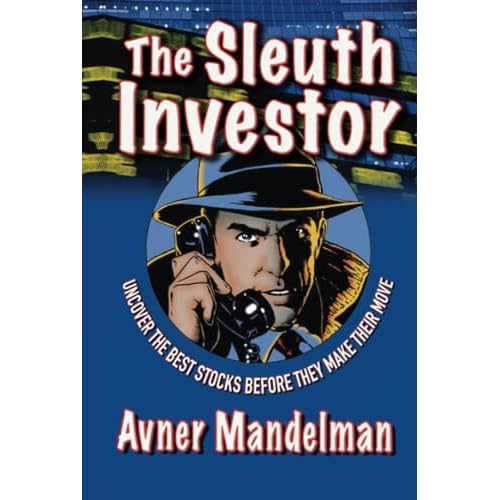
I could just tell right from the cover that this book, The Sleuth Investor, was going to be different from almost every investment book I've every read. Instead of a picture of Bulls or Bears, The Author, Dollars Floating in the Sky, or a Stock Exchange Building, instead there's a picture of what appears to be a private detective or, perhaps, a field operative. As I surmised from the cover, the book didn't disappoint.

And the dust cover picture cuts to the heart of the difference between this book and all the other investments books I've read. The difference between receiving second hand, "academic" information of stocks (eg annual and quarterly reports, etc.) or gathering that publicly available information, PLUS quality information directly from the field.

Note: If you're on a blog aggregator, you can visit the Confused Capitalist here for additional articles and exclusive content!

The author, Avner Mandelman, president and CEO of investment firm Giraffe Capital, tells you exactly how to sleuth out investment opportunities "in the field". He gives direct examples of what, who, how and when. This is not a book full of numbers and ratios; Mr. Mandelman knows full well that the investment world is full of these, yet the number of investors able to outperform the market is very few indeed.

In this book, he shows you how to both lower your investment risk profile, all the while increasing your odds of batting not just one, but numerous, investment home runs. While some investing books, such as Ken Fisher's "The Only Three Questions That Count: Investing by Knowing What Others Don't" state the importance of acquiring exclusive or near exclusive information, his book doesn't actually show you how to achieve that, since it only provides some further academic tools to suggest whether you might know something others might not know. On the other hand, if you apply Mr. Mandelman's suggested techniques, you'll know when you know something others don't when you are finished "sleuthing" a stock story.

I certainly haven't read any like it before, although there's hints of "One Up On Wall Street", by Peter Lynch here and there, and some visible heritage to "Common Stocks and Uncommon Profits", by Phillip A. Fisher. There's also some obvious lineage to Warren Buffett's ideas as well.

The book is a great read as well; it was the first investment book I've read since "On Up On Wall Street" by Peter Lynch that I when read it in bed, it was because it was so interesting, rather than because I intended as use it as a non-prescription sleep aid.

Canadian readers who've followed the business community here for a dozen years or so, will also especially savour a couple of the tales of "investment sleuths" from a couple of the high profile business stories and people here.

In one example, the "Z-Plat" story (almost certainly the Bre-X fraud) a sleuthing pension-fund manager saved his company a small fortune from physical sleuthing of a mining company's claim, and later turned that same information into a small personal fortune.

In another story, "Chipperware", Mr. Mandelman explains how he was able to turn a tidbit of public information about a piece of a one-of-a-kind designer clothing into a small fortune. One never knows of course, but many of the facts here appear to parallel some known public information about the wife of Corel Corporation's founder (Dr. Michael Cowpland), the flamboyant Marlene Cowpland, and an extremely expensive dress she wore to a gala.

Yes, as you read the stories of "Chipperware" and Z-Plat, be aware that these tales are almost certainly real business events as well.

In summary, this is an investment book that meets its dust cover promises. I cannot stress highly enough the importance of making this soon-to-be investment classic part of your permanent investment library.


JW

The Confused Capitalist

Friday, April 06, 2007

$124.93! Thank you!

I received my first cheque from Google for the ads running with my blog. Of course it's primarily based on volume of click throughs.

After 180 articles, and hundreds of hours spent maintaining and researching articles that ended up in this blog, I got my cheque of $124.93. Which ain't bad for a hobby I'd do for free; lucrative it's not, but it's nice to be able to take the Mrs. Confused Capitalist out for a nice dinner (or, as she's want to do, pay a couple of bills with it).

Note: If you're on a blog aggregator, you can visit The Confused Capitalist here for additional articles and exclusive content!

Luckily, I received a speeding ticket lately that'll nicely gobble up that cheque. The ticket cost? $124 even. Which leaves me trying to figure out what to do with the 93 cents.

In any case, thanks to my readers, and thanks for those who click through once in a while!

Oh, by the way, I recently received a copy of the newly-minted book "The Sleuth Investor" by the excellent Avner Mandelman. I am enjoying the book immensely and will provide a review of it very soon. It reads very well and provides considerable investing insight.


JW

The Confused Capitalist

Sunday, October 08, 2006

Informants in the investment process - rating and ranking

Separating good leads from bad is crucial in assessing investing leads. Avner Mandelman of Giraffe Capital has a method to do so.

Essentially, it's from a page stolen from spy agencies. In order to be able reliably assess information coming from a variety of informants, some sort of ranking system had to be devised.

These agencies rate their information from informants in two ways:

  1. Based on the past track record of the informant, and,
  2. Based on the informant's confidence in this particular piece of information.
Similarly, in assessing investing leads, whether they come from brokers, analysts, industry sources, customers, etc. we can assign a letter grade rank to each of the above. For instance, an industry source who has proved highly reliable in the past might be assigned a letter grade of "A", under point 1 above. Secondarily, they provide you with a particular piece of information that they claim they are highly certain is accurate (another "A", but under point 2, above).

This can provide you with a certain level of confidence in using this information as part of your investment process. For instance, an "A" ranked informant with an "A" piece of information would play higher in your investment process than a "B" informant, with "C" level information.

Mr. Mandelman even suggests that those so poor at any type of accuracy, can eventually become "A" level informants, by being contra-indicators. In other words, you studiously avoid their recommendations.

Of course, all of the above pre-supposes that you start tracking and rating your own informants, and keep those in your investment scrapbook. A worthwhile idea, in my view. By the way, I rate Mr. Mandelman as an "A" source.


JW

The Confused Capitalist

Monday, September 04, 2006

Distill Your Investment Choices

A recent story from the excellent Avner Mandelman of Giraffe Capital reminded me, once again, of one of the reasons I became a "focus" investor.

Mr. Mandelman relates a story of a old classmate asking for Giraffe's top ten stocks in 2003. Although Giraffe already ran a focussed portfolio of just 25 stocks, Mr. Mandelman agreed. One year later, the former classmate sent back the results of just those 10 stocks: those ten stocks actually doubled the overall performance of the already focussed portfolio (see link for overall 2003 performance).

Mr. Mandelmans point is to dive into your own stocks to both cull the weaker positions, and to add to those positions holding the best promise.

In fact, I also had a virtually identical experience when I ran the Global Walkers Investment Newsletter in the mid-to-late 1990s. I had two model portfolios, one of which ("The Top Ten"), which was a subset of a moderately larger (typically 20-25 stocks) portfolio. While both portfolios trashed the TSX index (its benchmark) over the two year period I ran them, the Top Ten, like Mr. Mandelmans experience, also doubled the broader model portfolio.

So I concur with Mr. Mandelman: don't be afraid to look in your own backyard for some of the best stock ideas out there. After all, there's already been considerable distilling (hopefully) of your ideas to arrive at those. Just a little further distillation can yield fabulous results!

A foolish diversification is the hobgoblin of little minds, adored by mutual fund managers, brokers and fitful investors alike.

(With all due apologies to Ralph Waldo Emerson)


JW

The Confused Capitalist

Saturday, March 25, 2006

Learning from the Newspaper

One of the things I always try to do, is learn from some of the good columnists in the financial pages. I tend to place less importance on temporal "stock tips or picks', than long term strategies. Picks come and go - and there are lots of them - but the best strategies help long-term performance and also change a mindset. Both are key to bettering oneself as an investor.

I'm lucky enough to read The Globe and Mail, and there's an infrequent column there by money manager Avner Mandelman, whose firm, Giraffe Capital, specializes in value-oriented tech situations. For those with the entry fee - $250,000 (CDN) - you get some outstanding performance. For readers of his column, you also get some advice on how to improve your long-term performance, some of which has come through Mr. Mandelman's own "school of hard knocks", including a recent confession that he originally "decimated" his own annual bonus not just once, but three times, by following standard stock-picking advice.

This led Mr. Mandelman on a journey to meet with successful private investors to learn their secrets. After an epiphany from legendary investor Jim Rogers brought it all together, Mr. Mandelman arrived at these five simple rules for outperformance:
  1. Look only for extraordinary opportunities; as a small investor, you don't have to invest if you can't find them, you can stay in cash.
  2. There aren't many extraordinary opportunities available - if you can't find them, then stay in cash.
  3. Be extraordinarily selective in buying and selling, and even in choosing stocks to research - the majority of stocks (at their price of the day), aren't even worth thinking about.
  4. Focus only on stocks in which you have special knowledge, or an exclusive niche. If you don't, those that do will take your money.
  5. Focus ruthlessly on price. Even if everything else is great, but the price isn't also great, then pass, and keep your cash.
There's probably nothing here that's extraordinary knowledge, but the discipline to maintain that it is "where the rubber hits the road". Giraffe once sat on 70% cash for the better part of a year, while awaiting extraordinary opportunities - which of course ultimately arrived.

Thanks to Mr. Mandelman for reinforcing these obvious truths (aren't all truths obvious, once they're laid down in a cogent, cohesive, manner?)

Keeping your cash while awaiting extraordinary opportunities - a simple wealth-creating strategy.


JW

The Confused Capitalist

Support this blog and our advertisers: check out the advertised listings.