Showing posts with label raising the median. Show all posts

Saturday, June 30, 2007

Raising the Median: Computer Hardware and Software

Image Source: MadAsHellClub.Net

I'm mad as hell and not going to take it any more! (Well, not really, but I am more than a bit disturbed [ask anyone who knows me] :-)

In any case, I've kind of had it with computer hardware and software makers who don't promote better ways to do things and perpetuate the mediocre or inferior.

One obvious example of this is the present keyboard you are probably typing on (just as I am). It's antiquated and inferior in two very obvious ways:
  • Firstly, the actual locale of the letters on the QWERTY keyboard layout, is a relatively slow method to type (created to slow typing down, so 18th century typewriters wouldn't jam). Because of this crappy letter layout, Repetitive Strain Injury (RSI) is epidemic among those regularly using keyboards. Additionally, it's a slow way to type, compared to several more modern alternatives, particularly a fairly new one that takes advantage of prior Qwerty training, while minimizing re-training time compared to using a Dvorak keyboard.

  • Secondly, the flat keyboard, with its offset letters, also contributes to RSI, to a higher error rate, and was something that was designed for the actual mechanics of a typewriter, never for the human being. That the computer makers chose to perpetuate this too when manufacturing computer keyboards, is even more unbelievable.

So, in relation to item #1 above, a Dvorak layout (which many of you may have heard about) is far superior to the standard Qwerty layout and results in superior speed (the world's fastest typist used a Dvorak layout), and less RSI. However, the problem is, is that almost every key (33 of them) is recast elsewhere on the board, with many also jumping between hands.

This results in a steep time-consuming learning curve, and many people give up because of this (as I did), even though you can easily reconfigure your keyboard through a software add-on (go to Microsoft, here, if interested). This is probably the reason that the Dvorak never caught on - the very steep learning curve.

No, based on this idea though, others have been at work to recast the keyboard letters, using the lessons of Dvorak, but minimizing extraneous key movement from the Qwerty standard, where gains are minimal. In the case of the Colemak layout (moves only 17 keys, and minimal moved to the "other" hand), this results in, reportedly, much smaller learning curve, with similar speed and ergonomic gains to Dvorak.

It is now the third-most popular English language layout, and is gaining converts every day. More information, including a downloadable program to convert your existing keyboard to this superior letter layout is located at Colemak.com. I hope to download and convert to this layout. I'll report out on this from time to time.

(Note: If you're on a blog aggregator, you can visit The Confused Capitalist here or here [http://confusedcapitalist.blogspot.com] for additional articles and exclusive content!)

Keyboard layout comparisons (click to enlarge any of the below):

QWERTY (The old-fashioned, crappy, standard)


DVORAK (A better keyboard, that never caught on, probably in part due to the learning curve - look how many keys not only shift position, but from one hand to the other).
COLEMAK (With some luck, this will become the defacto standard, particularly with young people. Note how many Qwerty positions are retained, because moving them doesn't create significant improvement and moving them needlessly creates more difficulty in learning a new board layout for old-timers, like me)


So if you're looking to be a faster typist, to alleviate your own RSI, and just generally to make the world a better place, head on over the Colemak.com for a free download to covert your keyboard. OK, that's Rant #1 over. Let's move onto Rant #2.
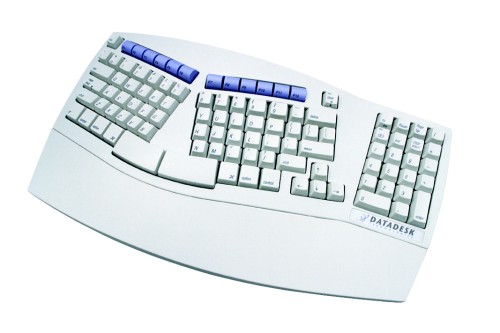
Secondly, the actual keyboard itself sucks! The hardware makers should have corrected the obvious deficiencies in this, once there was no mechanical reason to retain the "offset" configuration. It results in missed keys, too much finger stretching, and incorrect wrist position, among other problems. The Confused Capitalist has been researching this issue however, reading reviews on the net, and believes to have found a superior board.

While some boards split and twist the keyboard (like the Microsoft Ergonomic that I use at work) which solves part of the problem, it still leaves a large portion of the ergonomics unfixed. However, a newer board, called the SmartBoard, solves most of these problems and adds several other key fixes, as well. The SmartBoard is available from datadesktech.com - see image below.
Finally, rant #3, isn't really a rant, but more of an eye opener. Many people use the Microsoft Office programs without believing there's any real alternatives out there. Well, Open Office has been picking up speed lately, and similar in some ways to Linux, converts. It is a free, volunteer-maintained open source program, providing an array of office suite type products. By all accounts on the internet, the latest release is continuing to improve and now rivals most of the Microsoft suite for utility, versatility, sophistication, stability, etc.

In some cases, some of the programs are reported as superior, with the most notable complaints being for the Power Point equivalent "Impress" still not up to the Microsoft standard, while the spreadsheet program "Calc" isn't - for sophisticated users - as good as Excel. However, huge strides have reportedly been made over the prior release. According to my research, many users are reporting that they prefer the Open Office word processor. You can go to OpenOffice.org to download this FREE program. So, even if a couple of the programs aren't quite there yet, it's not hard to think they will be soon.
Oh, and did I mention that Open Office can both properly read and save back into a Microsoft format? So my only question would be - unless you have very sophisticated spreadsheet or presentation needs - why on earth would you spend the bucks to upgrade to the latest Microsoft suite?

By the way, many of you might note the label "Global Warming" below, and wonder how this bloggering possibly ties in with that theme. It's simple really - any improvement in efficiency offers the possibility of turning off the computer sooner, and therefore reduces power consumption. Further, less RSI means fewer trips to the doctor. Ergo, less greenhouse gas emissions.

Secondly, using Open Office, an open source document, means that you don't - perhaps - have to work quite as much, since you don't need to pay for this particular type of product. Ergo, the potential exists for a couple of less trips to work every other year. Times millions of workers = less greenhouse gas emissions.

Perhaps not obvious connections, but ones which can, and I believe, do, exist.

Well, that's it for now - I have all of these links on the right hand side of my blog, under the title "Computer Stuff". I hope you are able to use this to improve your own life - to "raise the median".


JW

The Confused Capitalist

Sunday, April 02, 2006

Raising the Median - Global Warming

For those who remain uncertain about global warming this news item just in: Canada shatters record for warmest winter ever recorded.

Canada shattered the record for the warmest winter ever, blowing away it away; its winter temperatures were some 7 degrees (Fahrenheit) above normal, and in the more northern parts of the country, it was closer to 12 degrees above normal. This is just as I have read since the mid-1980s, when the then feeble computers and climate science predicted that the far northern reaches of the planet would experience the most extreme shifts in weather.

I don't think I need to re-hash the debate from the fake science side, nor to get into a debate about other potential causes. Whatever might be contributing to the warming, it is occurring and we do know how to do something about it. We can have an influence on the rate of warming, at the very least, and at best, begin implementing long-term strategies aimed at reversing the damage.

Now, I know many of you are stock market aficionados, often with an interest in the underlying business fundamentals that makes picking stocks so interesting. I think that if many of you were looking at "The World, Inc.", what you'd see is a "deep value" investing situation. On the surface, there's lots of things wrong with the business - and perhaps it's on the verge of bankruptcy - but underneath, you believe that there's a very viable "turn-around" situation. However, an experienced turn-around CEO would probably be needed to review all the existing systems and to plan strategies for the survival of the business.

Environmentally, the litany of problems is well known, so I'll just focus on how some issues relating to global warming might be overcome.

Firstly, let's face it, national governments haven't shown much stomach for implementing some of the necessary remedies. Some of these would include national mass transit systems, city-to-city, that make rapid transit alternatives like bullet trains a real alternative to ozone-destroying and massive-polluting airplanes. I mean if people must commute back and forth between cities for business, let's build some environmentally-friendlier ways. Others would include very high standards for vehicle gas mileage, and national solutions for drastic reductions in global warming gases of all sorts.

But I digress. My focus is much more what can be done on the local (city) level and the state/provincial level. Here, taxes of all sorts could act as a disincentive to single-occupant vehicles and particularly the larger vehicles that produce 2-5 times as much warming gases as smaller efficient vehicles. The taxes could then be used to build out great transport systems, that could act as a real, viable, convenient, alternative to the single-occupant car.

Next, what about all our buildings? Of course, there's the usual array of energy-saving devices that could be outfitted - yes, some are more costly initially, but we need to think long-term here. Mandating a certain level of energy-efficiency in every new building on a local building code level - and backing it up with mandatory testing - could go a long way to producing a lower level of energy use.

And what about all the wasted space of building walls and roofs? How about mandating on a local building code level, that every building is required to produce 20, 30, 40, or even 50% of its own power usage, on site? This means making all those spaces more functional, equipping them with solar panels, mini-windmills, or other energy-creating devices - perhaps some yet to be invented. And of course the state governments would mandate that the surplus power created could be sold back "into the grid", thus further helping reduce other fossil-fuel use.

How about mandatory geo-thermal heating for all new buildings, which cuts heating costs in cold climates, and air-conditioning costs (and the associated global-warming gases too) in hot areas?

How about further mandating green roof systems in local building codes, where those systems make sense?

If we don't start acting very, very, very soon, the price will be too high - warm winters in Canada, and more of these things cleansing the Gulf Coast and Eastern US Seaboard of humanity and habitable areas ...

More resources: I highly recommend that you check out the following sites for practical ideas ...

  1. The respected Rocky Mountain Institute founded by Amory Lovins (full of practical ways to better respect the earth's capacity); and
  2. Greenpeace's climate change pages
In short, there's a whole lot that could be done, immediately, on local and state levels, without waiting for the inertia of national politics to be overcome by perennial disastrous occurrences.

As one final comment, we - as a society of peoples - need to recognize the reality of the last 100 years. That is, that we are more like the world's largest colony of ants and take advantage of that fact, rather than act like we're all single solitary foraging bears - the way we've built-out a lot of our systems to date.

Environmentalists - Raising the Sustainability Median!


JW

The Confused Capitalist

Sunday, March 19, 2006

Raising the Median - Averages

An average can be very misleading. For instance, knowing the average (mean) weight of ten mice and one elephant doesn't really tell you very much about each.

Yet this same measure, this average (mean) is often used to analyze economic policy and wealth, to see what effect it's having on the ordinary person, the so-called "average" person. Unfortunately, this is usually done by using the mean average, rather than the median average.

To use an extreme example, if ten people have exactly the same income, say $30,000 annually, but a change in economic policy results in just one person whose income zooms to $330,000 annually, but the rest remains the same, then policy-makers can claim that their policy was successful, as the average income doubled! Sure, great for the one guy, but the lot of the nine others hasn't changed at all. Successful policy? Or not?

A mean average can hide a multitude of sins. As Wikipedia says about a mean average ...
"It is used for many purposes and may be abused by using it to describe skewed distributions, with highly misleading results."
A much better but under-used measure for these sorts of things is, in my opinion, the median average. The median measures what change occurred for the very middle value of any array. In this case, it would show that a $30,000 annual income was still the normal value here. It definitely shows how the policy hasn't really changed the lot of the ordinary person.

So the next time you hear a news report claiming that the average (mean) has moved this way or that, ask the question - "But, what has happened to the median?" And maybe even fire them off an email. And make sure you ask the same of your politicians, and public bureaucrats. It can even be useful in your personal investing. It'll lead to better answers everywhere!

Jay Walker - Raising the Median!


JW

The Confused Capitalist

Sunday, March 12, 2006

Raising the Median - Innovation

Build a better mousetrap and ...

Our world suffers from an acute lack of innovation. That's right - that's what I think. Despite all the great new products in our world, we are unbelievably under-innovated.

And that's because we rarely stop to actually try to actively innovate in our businesses. As pointed out in a recent book review over at bankstocks.com, innovation doesn't have to be large. But way too often, we just proceed along our merry way, thinking we already have the best available.

One of my best stories in this regard is surgical tools. You'd think that those in the medical industry, and surgeons themselves, being smart, ambitious people, would be using the best possible medical implements, which MUST be subject to constant scrutiny for improvement and re-design. As it turns out, however, the scalpel hadn't really been changed for nearly 100 years. It's still essentially the same sharpened butter knife that it was back then. Difficult for a surgeon to hold and manipulate, and subject to cutting themselves or their co-workers.

Enter Lee Valley Tools with their quality wood-working tools and Dr. Bell. Turns out that many surgeons enjoy woodworking - it both clears their mind of worries, and improves their surgery skills. One day, Dr. Bell talked to the owner - Leonard Lee - and complained about corrosion on his carving tool. Mr. Lee was rather surprised, but asked what he was doing with it.

Dr. Bell replied ...
"Well, I've only autoclaved it about a half dozen times."
Obviously, Mr. Lee then realized it was being used for surgery. A wood-working tool turned out to be a better surgical instrument, than one which was supposedly "designed" for surgery. Read the rest of the story here, including the start of a brand new business for Mr. Lee.

Under-innovated; that's my opinion on our society. Let your employees mingle with some customers and suppliers, and some in other fields for one or two hours a month. Then ask them what innovations, large and small, they think that your business might be able to enjoy.

Other resources:

JW

The Confused Capitalist

Wednesday, February 22, 2006

Magic Formula Investing

Some people may have noticed the "Magic Formula" investing link on the right-hand side of my blog and wondered what that was all about. Well, the so-called "Magic Formula" is Joel Greenblatt's attempt to show two very basic key elements for outperforming the market.

Joel Greenblatt ran Gotham Capital for many years, producing a phenomenal 40% annual return. He has also written two books, the latest of which is the companion explanation to the "Magic Formula" investing site (although you don't have to read the book to benefit from the site). In short, he's a man with very serious credentials and practical experience. The stocks his "Magic Formula" picks ares ones that, in the aggregate, are able to outperform the market because they display two key attributes, which are:
  • They have demonstrated that they have earned a very high return on their capital, and
  • They are cheaply priced (by the inverse of the pe ratio, called the earnings dividend [this is quite different from a dividend yield]).

Back-testing by Professor Greenblatt (yes, he also teaches now, out of Columbia University) has shown a 30% annualized rate of return over the past few decades using the "Magic Formula."

I think that any value investor would recognize the aforementioned attributes as clearly offering potential for great investment returns, and Mr. Greenblatt's research confirms it. The link takes you to a screen that automatically generates the best of these prospects, depending upon certain parameters you enter. I highly recommend this site as a place either to invest on what I might call the Magic Formula "Index", or to use these as leads to uncover potentially lucrative stock prospects.

One more word about Mr. Greenblatt - he has invested his own money to "raise the median" in the New York public school system - a man after my own heart. Read the very fascinating story and the tremendous results he has achieved with the relatively small investment of $1,000 per student per year. We salute Mr. Greenblatt's attempts to "raise the median", both socially and economically!

Magic Formula - check it out ...

JW

The Confused Capitalist